






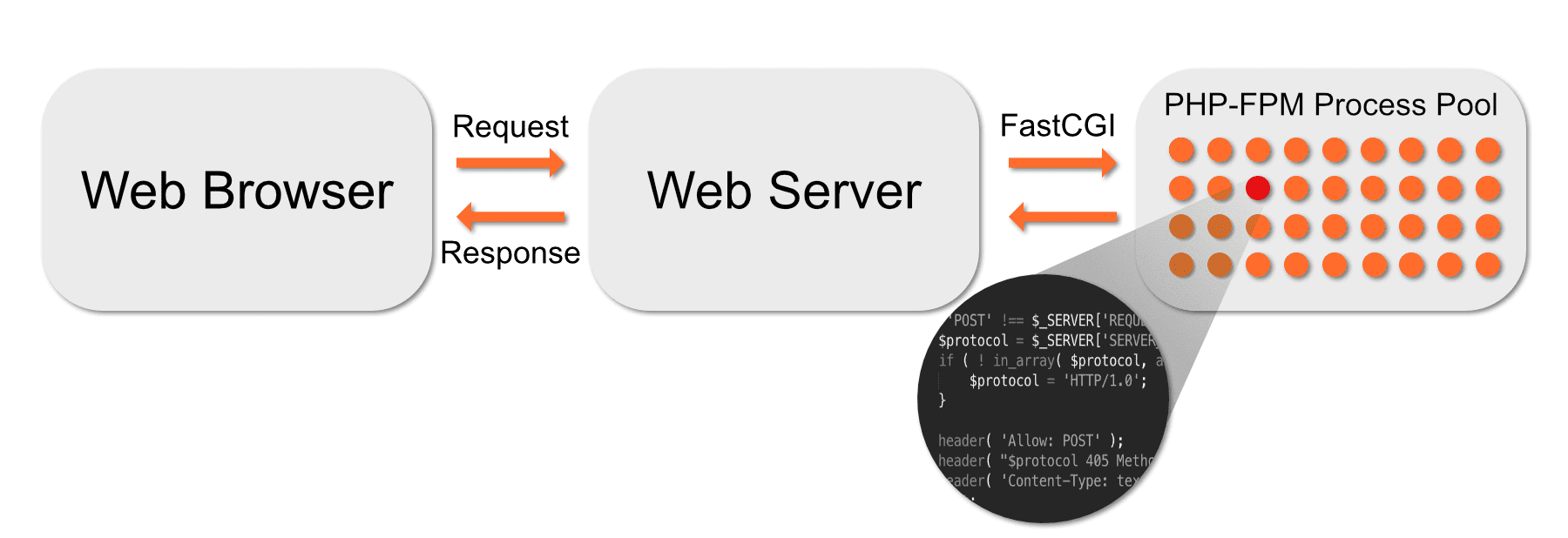
When you’re running a high-traffic Laravel application in production, PHP-FPM (FastCGI Process Manager) becomes the heart of your server-side execution. Misconfigurations at this layer can throttle performance, spike latency, and even crash your system under load. At InfraNext.co, we specialize in high-performance Laravel infrastructure, and this guide breaks down how to master PHP-FPM configuration to handle tens of thousands of concurrent requests efficiently.
Why PHP-FPM Tuning Matters for Laravel at Scale
Laravel is an elegant and expressive PHP framework—but under high load, its Eloquent ORM, queue workers, and middleware stack can overwhelm poorly configured FPM pools. PHP-FPM’s default settings are not production-ready for high-throughput applications. Without proper optimization, you’ll suffer from:
- 502 Bad Gateway errors from NGINX
- Slow Time-to-First-Byte (TTFB)
- Process exhaustion and request queuing
- Increased server costs due to poor CPU utilization
🔧 PHP-FPM Key Configuration Parameters for High-Concurrency Laravel Workloads
Here’s how to tune www.conf (or your custom pool file) for scalable performance:
1. pm — Process Manager
- Recommended:
pm = dynamic - Allows PHP-FPM to scale processes based on demand.
2. pm.max_children
- Controls: Maximum simultaneous PHP processes.
- Set to:
Total RAM / Average PHP process size - For example: 16GB RAM / 60MB = ~266
3. pm.start_servers, pm.min_spare_servers, pm.max_spare_servers
- Start with: iniCopyEdit
pm.start_servers = 20 pm.min_spare_servers = 10 pm.max_spare_servers = 40
4. pm.max_requests
- Controls: How many requests a child process handles before respawning.
- Prevents memory leaks.
- Recommended:
500 - 1000
5. request_terminate_timeout
- Prevents runaway scripts.
- Recommended:
30s - 60sdepending on your API or queue load.
🚀 Advanced Tuning Strategies for Laravel Applications
A. Optimize Laravel Bootstrap Performance
- Cache config, routes, and views: bashCopyEdit
php artisan config:cache php artisan route:cache php artisan view:cache
B. Use Opcache Aggressively
Enable and tune opcache in your php.ini:
iniCopyEditopcache.enable=1
opcache.memory_consumption=256
opcache.interned_strings_buffer=16
opcache.max_accelerated_files=10000
C. Deploy NGINX with Event-Driven Model
- Combine NGINX + PHP-FPM with
worker_processes auto;andworker_connections 10240; - Use
keepaliveand Gzip to improve response time.
🧠 Laravel-Specific Tips for PHP-FPM Performance
- Queue Workers: Use
supervisordto run multiplephp artisan queue:workinstances tuned per queue. - Session Drivers: Use
RedisorMemcachedinstead of file/session DB. - Cache Store: Offload heavy caching to Amazon ElastiCache or Redis Cluster.
- Database Optimization: Combine with a well-tuned AWS Aurora or RDS MySQL/PostgreSQL backend.
🧪 Monitoring, Metrics & Observability
For mission-critical apps, you need continuous observability:
- Use New Relic, Datadog, or Blackfire to monitor PHP-FPM metrics.
- Track:
slowlogrequest_slowlog_timeoutmax_children_reached(critical to detect)
Enable slowlog in your pool config:
iniCopyEditrequest_slowlog_timeout = 5s
slowlog = /var/log/php-fpm/www-slow.log
🌐 PHP-FPM in a Load-Balanced, Containerized Environment
In Kubernetes or Dockerized Laravel apps:
- Use horizontal pod autoscaling (HPA) for Laravel containers.
- Mount a shared persistent session store (e.g., Redis).
- Load-balance across PHP-FPM backends via NGINX Ingress or AWS ALB.
✅ Final Checklist for High-Traffic PHP-FPM + Laravel Deployments
- Set
pm.max_childrenbased on memory profiling - Tune
max_requestsandspare_serversintelligently - Enable and configure Opcache
- Run queue workers via
supervisordor systemd - Monitor
max_children_reachedand slowlog - Cache everything: config, views, routes, queries
Conclusion: Scale Laravel with Confidence
By mastering PHP-FPM tuning, Laravel developers and DevOps engineers can drastically reduce request latency, avoid bottlenecks, and serve millions of users without a hitch. Combine this with NGINX tuning, Redis caching, and Aurora optimization, and you’ve got a scalable, resilient web infrastructure ready for anything.
Need help tuning PHP-FPM for your Laravel stack?
Contact InfraNext.co for white-glove infrastructure optimization, performance audits, and DevOps automation designed for high-scale PHP applications.


Leave a Reply